Hierarchical Routing
The basics
- Aggregate routers into regions - Autonomous Systems (AS)
- Routers in same AS run same Intra-AS routing protocol, routers in different AS can run different protocols
- Gateway Router is a direct link to router in another AS
See also What is an Autonomous System | Cloudflare
Forwarding table is configured by both intra- and inter-AS routing algorithm
- Intra-AS sets entries for internal destinations
- Inter-AS and intra-AS sets entries for external destinations
Inter-AS v Intra-AS
Suppose router in AS1 receives datagram for which dest is outside of AS1, router will forward the packet towards one of the gateway routers. AS1 needs
- To learn which dests are reachable through
AS2and which throughAS3 - To propagates this reachability info to all routers in
AS1
These are all done through Inter-AS Routing
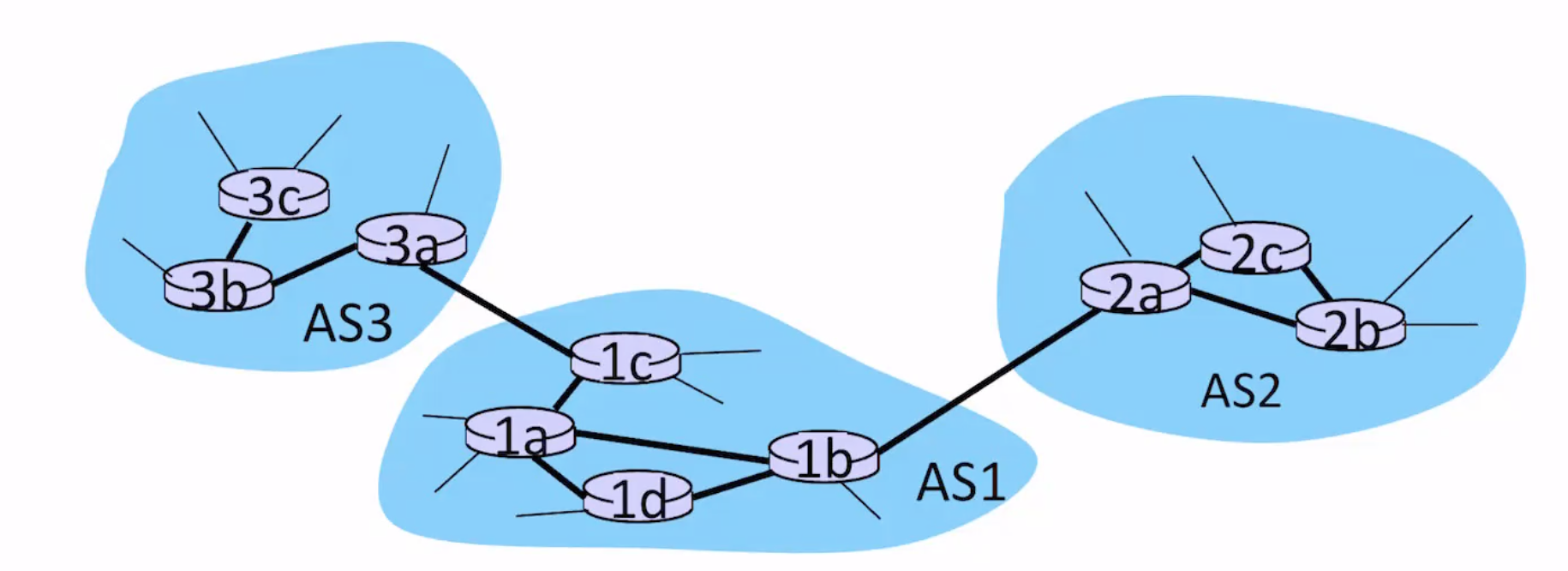
Suppose AS1 learns from the inter-AS protocol that subnet x (in AS3) is reachable from AS3 (gateway 1c) but not from AS2
- Inter-AS protocol propagates reachability info to all internal routers
- Router
1ddetermines from intra-AS routing info that its interfaceIis on the least cost path to1c - Puts in forwarding table entry
(x,I)
Suppose AS1 learns form the inter-AS protocol that subnet x is reachable from AS3 and AS2
- To configure forwarding table, router
1dmust determine towards which gateway it should forward packets for destx - This is also the job on inter-AS routing protocol
- Hot Potato Routing: send packet towards closest of two routers
(doesn't care about inter-AS traversal, only cares about getting the packet out of my AS as quick as possible, saves traffic in my own AS)

Why different Intra and Inter-AS routing?
- Policy
- Inter-AS: admin wants control over how its traffic routed, who routes through its net
- Intra-AS: single admin, so no policy decisions needed
- Scale
- Hierarchical routing saves table size, reduced update traffic
- Performance
- Intra-AS: can focus on performance
- Inter-AS: policy may dominate over performance
Inter-AS Protocols
Routing across different ASs
BGP (Border Gateway Protocol)
BGP provides each AS a mean to
- Obtain subnet reachability information from neighboring ASs
- Propagate the reachability information to all routers internal to the AS
- Tells nodes who the gateway routers are, but not how to get to them (this is intra-as)
- Determine "good" routes to subnets based on reachability information and policy
Allows a subnet to advertise its existence to rest of the Internet: "I am here"
BGP Basics
- Pairs of routers (BGP Peers) exchange routing info over semi-permanent TCP connections: BGP Sessions
- Note that BGP sessions do not correspond to physical links
- When AS2 advertises a prefix to AS1, AS2 is promising it will forward any datagrams destined to that prefix towards the prefix
- AS2 can aggregate prefixes in its advertisement
- Two types
- eBGP: between gateways of ASs
- iBGP: between routers inside an AS (responsible for announcing reachability info)

Distributing reachability info
- With eBGP session between
3aand1c, AS3 sends prefix reachability info to AS1 1ccan then use iBGP to distribute this new prefix reach info to all routers in AS11bcan then re-advertise the new reach info to AS2 over the1b-to-2aeBGP session- When router learns about a new prefix, it creates an entry for the prefix in its forwarding table
Path attributes and BGP routes
- When advertising a prefix, advert includes BGP attributes
- Prefix + attributes = route
- Two important attributes
- AS-PATH: contains the ASs through which the advert for the prefix passed
(which ASs the packet went through) - NEXT-HOP: indicates the specific internal-AS router to next-hop AS
(which internal next-hop inside your AS is, there may be multiple)
- AS-PATH: contains the ASs through which the advert for the prefix passed
- When gateway router receives route advert, uses import policy to accept/decline
BGP Route Selection
- Router may learn about more than 1 route to some prefix. Router must select route.
- Elimination rules:
- Local preference value attribute: policy decision
- Shortest AS-PATH
- Closest NEXT-HOP router: hot potato routing
- Additional criteria
BGP Messages
BGP messages exchanged using TCP
OPENUPDATEKEEP ALIVENOTIFICATION
BGP Routing Policy
A,B,C are provider networks
X,W,Y are customer (of provider networks)
X is dual-homed: attached to two networks
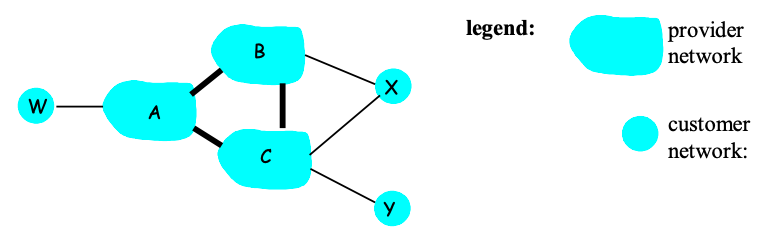
X does not want to route from B via X to C
so X will not advertise to B a route to C
A advertises to B the path AW
B advertises to X the path BAW
Should B advertise to C the path BAW?
- No. B gets no “revenue” for routing CBAW since neither W nor C are B’s customers
- B wants to force C to route to w via A
- B wants to route only to/from its customers
Intra-AS Protocols
Routing within the same AS
Also known as Interior Gateway Protocols (IGP)
RIP (Routing Information Protocol)
Routing Algorithms#Distance Vector Algorithm (bellman-ford, overall topology unknown)
- Distance metric is number of hops (max = 15 hops)
- Distance vectors: exchanged among neighbors every 30s via Response Message
- Also called advertisement
- Each advertisement list of up to 25 destination nets within AS
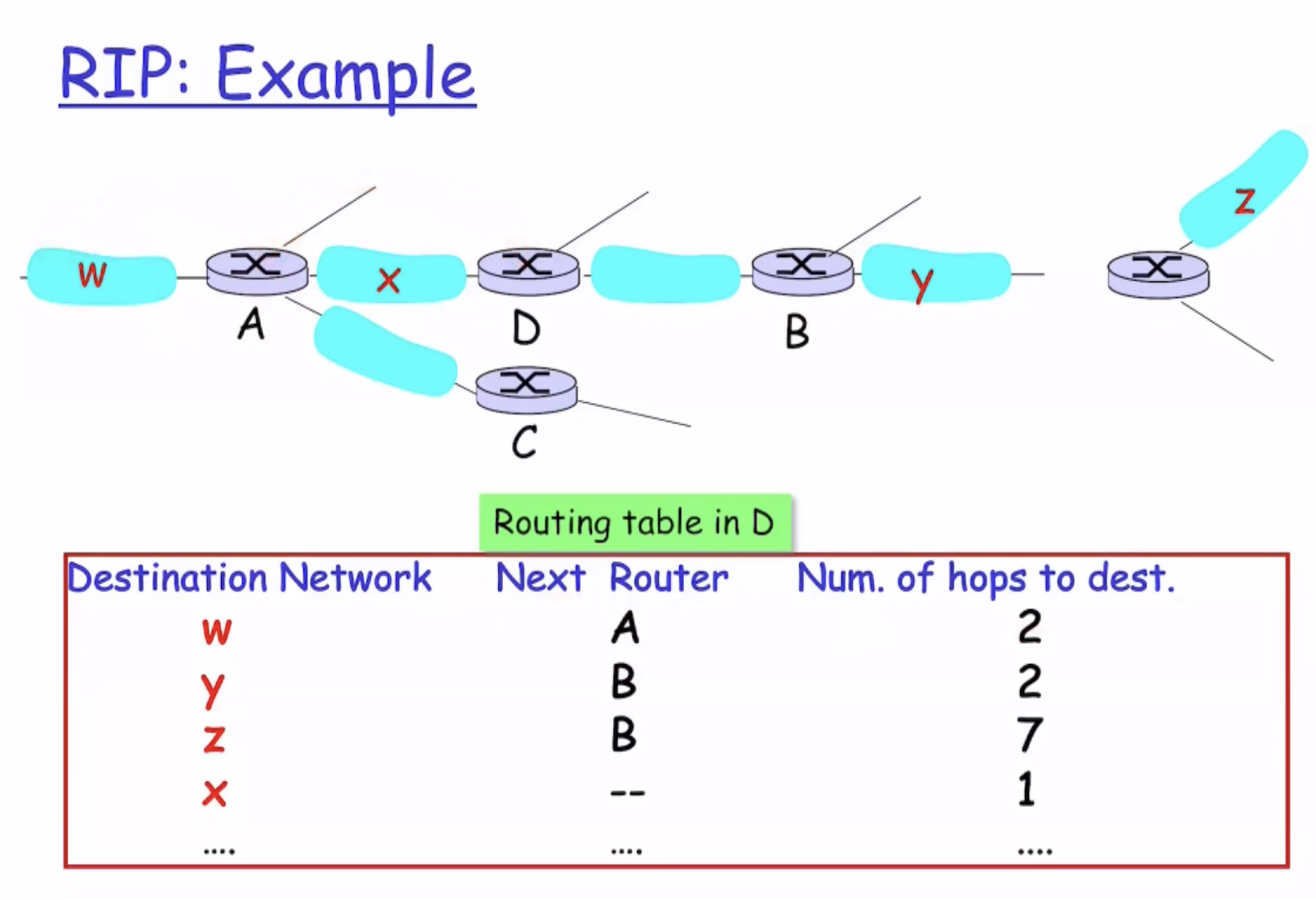
Example routing table for D
Link failure and recovery
- If no advertisement heard after 180s, neighbor/link declared dead
- Routes via neighbor invalidated
- New advertisements sent to neighbors
- Neighbors in turn send out new advertisements (if tables changed)
- Link failure info quickly propagates to entire net
- Poison reverse used to prevent ping-pong loops (infinite distance = 16 hops)
RIP table processing
- RIP routing tables managed by application-level process called route-d (daemon)
- Advertisements sent in UDP packets, periodically repeated
OSPF (Open Shortest Path First)
Routing Algorithms#Link-State Routing Algorithm (dijkstra's, overall topologies known)
- OSPF advertisement carries one entry per neighbor router
- Advertisements disseminated to entire AS (via flooding)
- Carried in OSPF messages directly over IP (rather than TCP or UDP)
OSPF advanced features that is not in #RIP (Routing Information Protocol)
-
Security: messages authenticated
-
Multiple same-cost paths allowed
-
For each link, multiple cost metrics for different types of services
Example: satellite link cost, email, set "low", high for real time
-
Integrated uni- and multicast support
-
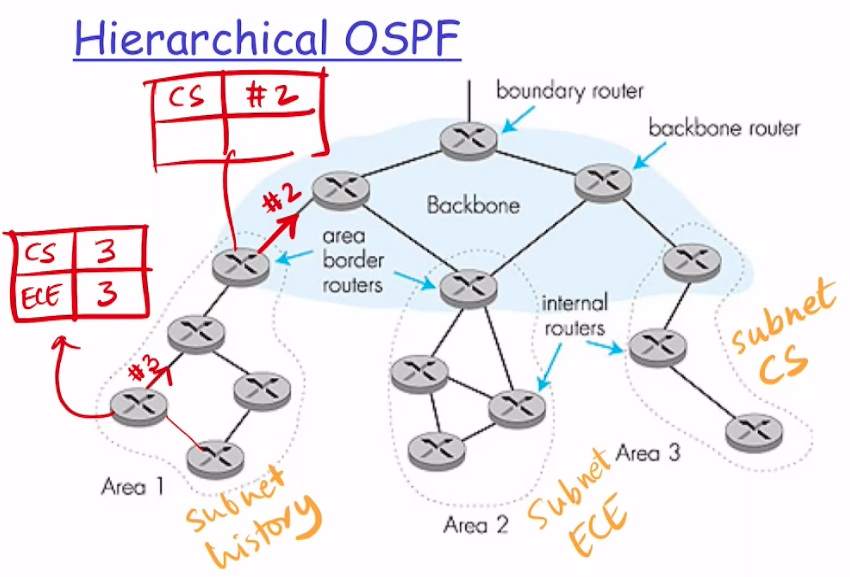
Hierarchical OSPF in large domains